Showing posts with label police procedural mysteries. Show all posts

Wednesday, September 27, 2017

Guest Post: Deputy Tempe Crabtree and the Food She Eats


I want to warmly welcome Marilyn Meredith back to Parsley, Sage, and Rosemary Time with another interesting post and with an announcement of her latest book. Marilyn is prolific and professional and personable. I am glad to count her among my friends. Enjoy!
 

Deputy Tempe Crabtree and the Food She Eats

Someone told me that Tempe and Hutch sure ate a lot in Not as It Seems. They’ve gone to Los Osos for their son’s wedding—and yes, there’s a lot about food. There are many great restaurants in the area and they had to eat somewhere. They also eat Ethiopian food at their soon-to-be in-laws’ home, and of course at the wedding reception.

I think one of the reasons I write about what my characters eat in so many of mysteries could be because in so many books I read, the main characters don’t seem to eat at all. I find that so strange—how do they keep up their strength for all the amazing physical feats?

Deputy Crabtree doesn’t do much cooking, but her husband does and though it’s usually simple fare I do write about it in many books.

In Seldom Traveled there is a lack of food because of the dilemma Tempe finds herself in.

In my latest in the series, A Cold Death, they are stranded in a summer camp during a winter storm with the owners of the camp and their guests as well as the caretakers, a husband and wife. The wife is a great cook. Yes, I wrote about all the meals, because if I were in that same situation, I’d be looking forward to what I was going to eat next.

Some of the menus I wrote in about in A Cold Death were what I’ve eaten at different camps I’ve attended as an adult, others are what I would have cooked had I been responsible for the meals. And yes, sometimes when I’m writing I make myself very hungry.

Marilyn

Would you like to share this post with others who like a good mystery? Copy/paste these for your posts.
Facebook:Marilyn Meredith wonders how book characters survive since they never seem to eat! Not in her books! Check out the foods and the mystery in A COLD DEATH at 

Twitter: @MarilynMeredith has a new Tempe Crabtree mystery out and she dishes about food in books at

Blurb for A Cold Death:

Deputy Tempe Crabtree and her husband answer the call for help with unruly guests visiting a closed summer camp during a huge snow storm and are trapped there along with the others. One is a murderer.

Anyone who orders any of my books from the publisher‘s website: http://mundania.com
can get 10% off by entering MP20 coupon code in the shopping cart. This is good all the time for all my books, E-books and print books.

On Kindle: A COLD DEATH
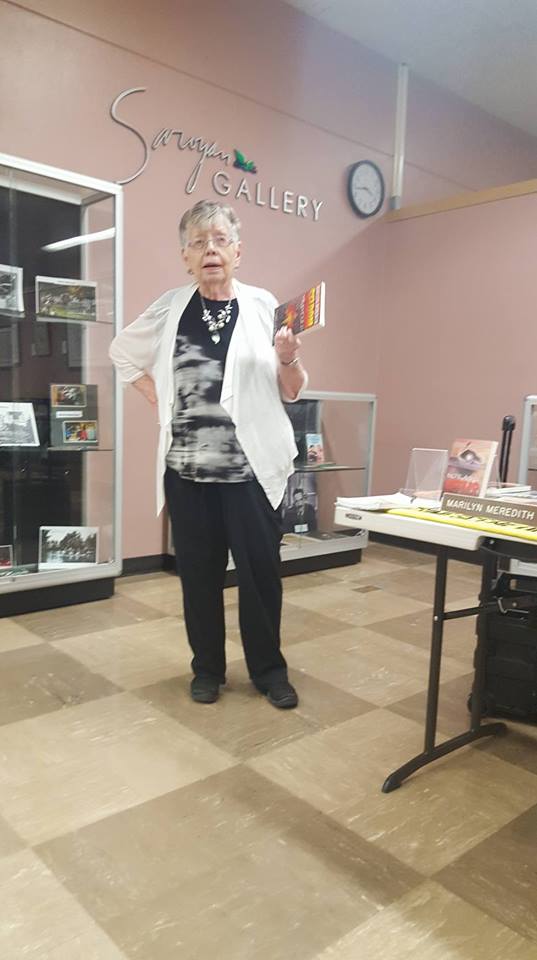
Marilyn Meredith’s published book count is nearing 40. She is one of the founding members of the San Joaquin chapter of Sister in Crime. She taught writing for Writers Digest Schools for 10 years, and was an instructor at the prestigious Maui Writers Retreat, and has taught at many writers’ conferences. Marilyn is a member of three chapters of Sisters in Crime, Mystery Writers of America, and serves on the board of the Public Safety Writers of America. She lives in the foothills of the Sierra, a place with many similarities to Tempe Crabtree’s patrol area. Webpage:  http://fictionforyou.com Blog:  http://marilymeredith.blogspot.com/ and you can follow her on Facebook.

Contest: Once again I’m going to use the name of the person who comments on the most blogs on my tour for the next Deputy Tempe Crabtree mystery—which may be the last in the series.


Tomorrow I’ll be here:  September 28
How Sisters in Crime has Helped Me with My Writing Career

Monday, July 31, 2017

Are Cozies "Real" Mysteries?


Well, of course they are! However, in the mystery/thriller world cozies are the equivalent of “the little lady”, nice enough but somewhat insubstantial, easily dismissed as a lightweight with little to offer.

Is my bias showing? Absolutely! Why is there always a pecking order? Pecking Order Syndrome shows up in all sorts of places, and ultimately, racial discrimination can be traced to it. As a kid growing up in a family of West Virginia hillbillies living in Ohio, I remember the prejudice my parents exhibited and believed.

Did my term “West Virginia hillbillies living in Ohio” send you a signal? It should have. Hill people from Tennessee, Kentucky, and West Virginia who had moved to Ohio for jobs, were looked down on. Hillbillies were denigrated by the dominant and native white group. So, hillbillies had to make a group lower than they were on the social scale. The hillbillies of my acquaintance uniformly disliked Blacks. It was their way of feeling better about themselves.

Translating the Pecking Order Syndrome to novels, in the mystery/thriller world, thrillers are more highly regarded than mystery. International thrillers top domestic thrillers for sophistication and cross-country plotting and travel. But both are viewed as superior to mysteries.

Among mysteries, the traditional mystery is still Queen of the Hill. These classic mysteries are revered. For the rest of the subgenres, there is also a pecking order. Police procedurals and medical mysteries with all the technical detail and knowledge required are superior (in many eyes) to other mysteries.

And the lowly cozies—aren’t they cute little things—are at the bottom of the heap.

Oh, yeah? Well, listen up, Bud. Plotting any mystery, laying out the clues, pacing the action, finding relevant subplots, and creating compelling characters is identical in every mystery/thriller written.

You don’t have to have blood and gore on the page for the essential mystery. That’s just the value-added that police procedurals and thrillers bring to the party. The value-added for cozies is learning about a hobby or special interest of the author.

I am a pretty good cooker and know a lot about food. A retired police detective knows a lot about how crooks are caught and treated. Both of us are experts in our fields. Expertise is the commodity that both cozies and thrillers and other mystery subgenres share. Should we value one kind of expertise more than another?

I don’t believe so. What I prefer to read is merely that, a preference. Given great writing, expertise should be valued in any subgenre. 


If you think others would be interested in this post, please share on social media. I’ve prepared a couple of posts you can cut and paste or create your own.

Facebook: “I don’t get no respect,” might be what the cozy mystery genre might say were it able to talk. Do you agree that many regard cozies as an “also ran” kind of mystery? http://bit.ly/2uQq73K

Twitter: Are cozy mysteries equivalent to traditional mysteries or are they just fluff? @good2tweat offers her viewpoint at http://bit.ly/2uQq73K
 

Tuesday, January 20, 2015

The Mystery of Mysteries: 10+ Tips for Writing Police Procedural Mysteries

Police Procedural and True Crime mysteries (coming next week) share some common elements while retaining their distinctive differences. The major difference is that police procedurals are fiction, and true crime mysteries are creative non-fiction.

In a Police Procedural, the writer must adhere to the basic elements of mysteries while at the same time incorporating what makes the story a police procedural. Sometimes it can be hard to distinguish a thriller from a police procedural novel since thrillers also may be filled with lots of detail about the crime(s) and how solved. Because it must be solved. That is part of the covenant between writer and reader.

Additionally, in order to be classed as a police procedural mystery:

1) The investigator is a professional in the public safety world. The investigator might be a police officer, detective, EMS person, firefighter, and so on.

2) The emphasis is on factual operations of police investigations rather than on character development. Characters tend to be tropes, but investigative rules must be followed.

3) The perpetrator may or may not be known from the beginning.

4) There can be one crime or more than one. If more, the crimes may seem unrelated but connect somehow. Or the novel may feature several unrelated crimes being processed by the precinct or department and have multiple investigators, a sort of ensemble cast.

5) Solving the crime is a group effort. Police procedurals demonstrate a range of police techniques including forensic, interrogation techniques, arrest and search warrants, interviews, autopsies, and behavioral science protocols.

6) Police procedurals provide details of the crime scene investigation, from gathering evidence to processing it. A realistic portrayal is demanded. A team is needed for different aspects of the investigation.

7) There is typically a graphic description of the crime scene. Violence often takes place “on stage” with varying degrees of explicit violence or gore described. Sometimes it is provided through the investigator’s reconstruction of the crime.

8) The POV can be entirely or mainly from the professional investigator’s stance. Or the villain’s POV may alternate to show his/her thinking, particularly if a crime spree is depicted.

9) The crime’s perpetrator in police procedurals, though not always in real life, is a worthy intellectual foe for the investigator.

10) Extremely intensive research to write police procedurals includes spending time with safety professionals as they work, if at all possible. If not, spend other time with them to get the small details right.

If you want to read more about types of mysteries and how to write them, check out my June-December mystery posts on the second Tuesdays at Writeon Sisters and search this "Parsley, Sage, and Rosemary Time" blog for earlier posts.

Before writing a police procedural mystery, read these authors. Of course, there are many other great ones, too!
Tess Gerritsen     
Thomas Harris    
Tony Hillerman    
Ed McBain    
Louise Penny   
Martin Cruz Smith